

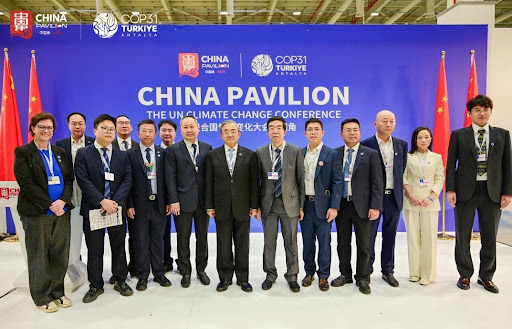
On 13 November 2026, the side event “Global Climate Action and Inclusive Regional Transition: Practice, Innovation and Cooperation” took place at the China Pavilion in Antalya, Türkiye, during the 31st Conference of the Parties to the United Nations Framework Convention on Climate Change (COP31). Liu Zhenmin, China’s Special Envoy for Climate Change, delivered remarks. The WFEO-CEE was represented by Chair, Prof. Yong GENG, who delivered a keynote address, and Secretary-General, Prof. Meng LI.
The event was jointly organized by the United Nations Environment Programme (UNEP), the Institute of Geographic Sciences and Natural Resources Research of the Chinese Academy of Sciences, with support from WFEO-CEE, Shanghai Jiao Tong University, and other institutions. It brought together representatives from international organizations, government agencies, research institutions, and industry to discuss how climate commitments can be put into practice. Focusing on global climate action and an inclusive green transition, participants explored how climate goals can drive industrial upgrading, economic development, and social inclusion.
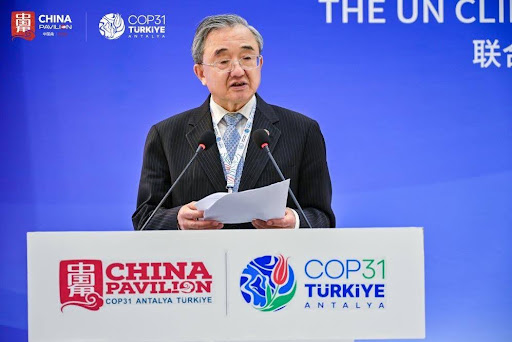
Liu Zhenmin believed that global climate governance had reached a critical stage as countries move from setting targets to implementing them. He stressed that the green and low-carbon transition should advance economic development, regional coordination, and social inclusion. He reiterated China’s commitment to implementing its national strategy on climate change and making steady progress toward peaking carbon emissions and achieving carbon neutrality. Under its 2035 nationally determined contribution (NDC), China aims to reduce economy-wide net greenhouse gas emissions by 7–10 percent from peak levels by 2035 and will strive to do better.
In his keynote address, “Resource Management for Climate Action: Pathways towards Carbon Peak and Neutrality,” Prof. Yong GENG examined how growing resource demand links climate change, resource use, and industrial transformation. He noted that the energy transition and the development of emerging technologies depend on innovation in clean energy technologies as well as on a sustainable supply and efficient use of critical minerals.
Prof. Geng reviewed the metal requirements and technical characteristics of nuclear power, wind power, solar photovoltaics, hydrogen energy, semiconductors, data centers, and robotics. He showed how technology choices, key components, and material selection shape demand for metals. He called for coordinated planning for primary and recycled material supplies and stronger resource management across the full life cycle to cut emissions, safeguard resource security, and strengthen industrial resilience.
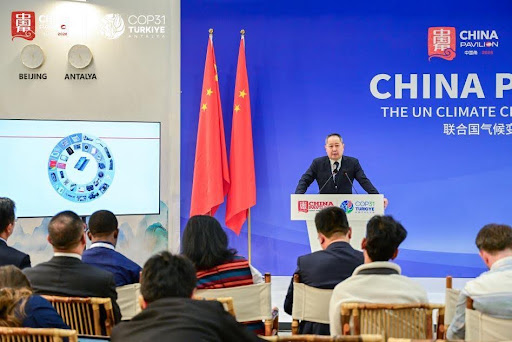
Experts and researchers from around the world shared recent findings and technological advances and discussed the challenges and opportunities presented by climate change. The event underscored the shared responsibility of all countries to mitigate climate change and adapt to its impacts.
NOV
2026