
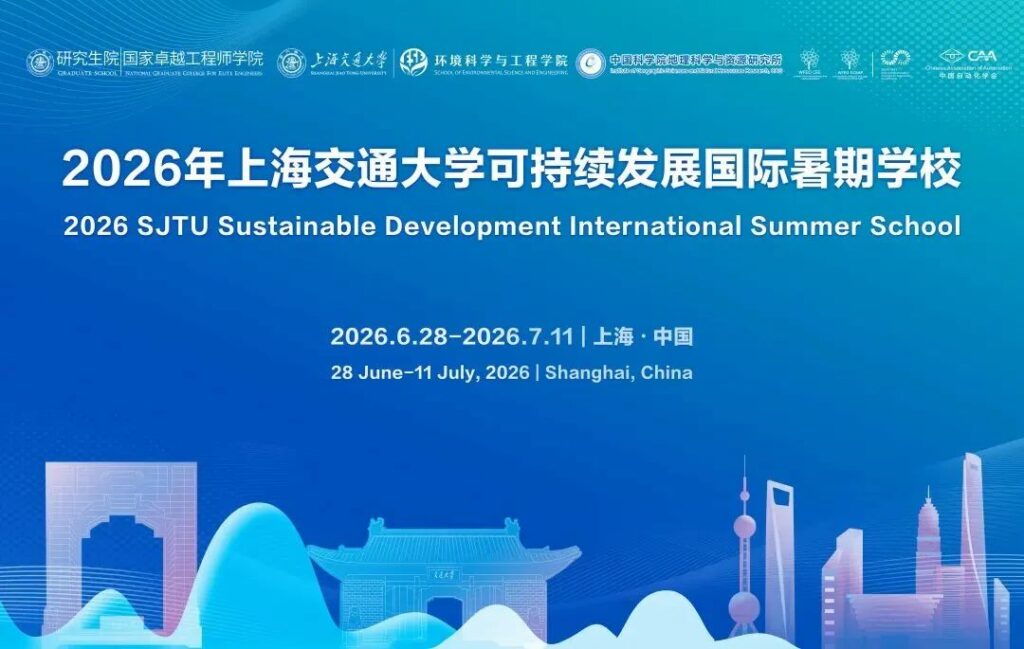

The 2026 Global Summer School on Sustainability was successfully held in Shanghai, China, from 28 June to 11 July 2026. Jointly led by the Committee on Engineering and the Environment, World Federation of Engineering Organizations (WFEO-CEE) and Shanghai Jiao Tong University (SJTU), and co-organized by the Engineering Capacity Building for Africa Programme, World Federation of Engineering Organizations (WFEO-ECBAP), the Institute of Geographic Sciences and Natural Resources Research , Chinese Academy of Sciences (IGSNRR, CAS), and the Chinese Association of Automation (CAA).
Under the theme “Global Climate Governance and Sustainable Development,” the two-week programme brought together more than 40 students from 24 countries and regions, with international students accounting for 88% of all participants. Representing diverse academic backgrounds, including energy, environmental studies, public policy, economics and management, and international law, the participants engaged in interdisciplinary learning and international exchange.

The programme featured academic lectures, expert discussions, industry visits, cultural exchange activities, and collaborative research. Experts from leading universities and research institutions, including SJTU, the University of Cambridge, and the University of Leeds, addressed key topics such as climate change, resource management, carbon neutrality, the circular economy, sustainable trade, green technologies, and the United Nations Sustainable Development Goals.

To connect academic learning with practical experience, participants visited the Shanghai Environment and Energy Exchange, a humanoid robotics innovation incubator and exhibition centre, and Chint Group in Hangzhou. The visits provided insights into China’s carbon market, green finance, intelligent manufacturing, renewable energy, and corporate green transformation.


The Summer School represents an important initiative by WFEO-CEE to promote international youth exchange, engineering capacity building, and knowledge sharing in response to global environmental and climate challenges. Through collaboration among international engineering organizations, universities, research institutions, and industry partners, the programme further strengthened WFEO-CEE’s cooperation network and contributed to cultivating a new generation of young professionals committed to sustainable development.
JUL
2026